
Share this
by Jed Taylor, guest contributor
A timely look at the shifting reality of AI in financial services and what it means for community banks and credit unions navigating rapid change.
As I was preparing to write this blog, I started noticing something that surprised me. The public conversation around AI was shifting, and fast. Not long ago, the energy was almost universally electric. Every conference speaker, every business article, every leadership off-site had AI at the center of it. It seemed that the sentiment was close to euphoric.
That's changed. The mood has swung, and in some corners, dramatically. What started as enthusiasm for AI has, for a growing number of people, curdled into something closer to outright rejection. The calls aren't just for slowing down anymore. Some are calling for abandoning the technology altogether. I first noticed this shift when I read about a commencement speaker at the University of Central Florida who was booed for calling AI “the next industrial revolution.” That wasn't a tech-skeptic crowd. It was a college graduation full of Gen Z students.[1]
I think reflecting on the shift from hyperexcited to hostile is important to consider if you’re leading a community bank or credit union right now, because whether you like it or not, you’re navigating both the technological and social dimensions of AI’s rise.
What does it mean for your institution to use AI in a way that holds up two years from now? What vendors can you trust to deliver the newest AI promises? Will your members or customers adopt the technology? Will regulators be able to move at the pace of AI innovation? And when the next wave of AI promises lands on your desk, how will you know the difference between a real solution and an inflated expectation?
Those aren't rhetorical. I’m raising them because I think they’re the questions worth considering before taking action on AI.
The pain of getting AI wrong
In May 2025, Klarna’s CEO went public with an awkward admission. The company was hiring human customer service agents again.[2]
Why is that awkward? Fifteen months earlier, the same CEO had announced that an AI chatbot was doing the work of 700 staff. It was the headline AI-in-finance story of 2024. Cost savings, scale, the future of service delivery. The market loved it.
Then the satisfaction numbers came in. Resolution quality and customer trust both dropped. The same CEO who’d celebrated the chatbot publicly walked it back, telling reporters the company had cut too deep and that customers wanted the option to talk to a real person.
If a fintech-native lender with billions in revenue can swing this far and walk it back inside 15 months, the question for community bank and credit union executives isn’t whether to invest in AI. It’s whether the AI commitments you make this quarter will still look smart by your next board meeting.
You can make a careful, well-researched decision today and have it look reckless six months from now. Not because you got it wrong. Because the ground moved.
Is your AI adoption too fast or too slow?
Filene surveyed 110 leaders across 78 credit unions in 2025 and found a familiar tension. Leaders are worried about moving too fast. They’re equally worried about falling behind. In other words, nobody knows what the right pace is.[3]
The pace problem isn’t really a pace problem. The interval between making a good decision and watching it become a bad one keeps getting shorter. A three-year vendor contract signed in 2024 is now exposed to a market that has seen major AI model generations and new capabilities launch every few months, each seemingly disrupting the prior AI deployments. Your vendor decision didn’t change, but everything around it did.
So the question on the table isn’t “should we use AI?” It’s “how do we make decisions about AI when the shelf life of those decisions has collapsed to under twelve months?”
The vendor decision when the vendors are fluid
94.8% of fintech executives reported facing vendor-related risk in the prior three years.[7] In a fast-moving industry like AI, the scramble for success can create a graveyard of also-ran vendors or even vendors that lack relevance when the next AI model is released. For example, Builder.ai, the Microsoft-backed AI software platform, filed for insolvency in May 2025 and stranded its AI mobile app customers mid-build.[8] It seems that the vendor market is more unstable now, not less.
Your due diligence must change. Most institutions are still using a procurement framework built for stable SaaS vendors. AI isn’t stable SaaS. Treating it that way is how you wake up to find your vendor’s been sold and your roadmap orphaned.
The prevalence and magnitude of the large AI frontier models create a new type of vendor problem. The Consumer Bankers Association argued in October 2025 that midsize banks need risk-based third-party guidance because the market power mismatch between large AI vendors and community institutions has gotten so wide.[11] FIs are forced to play by their rules or not play at all.
The trust deficit
AI’s recent public erosion of trust surprised me and I think it surprises many tech-leaning executives too. But the cultural backlash against AI is real, it’s growing, and it’s likely to hit relationship-based institutions like credit unions and community banks harder than fintechs and the major banks.
A May 2026 Economist/YouGov poll found over 70% of Americans say AI is moving too fast: 68% of Republicans, 77% of Democrats.[4] Gallup found only 18% of 14-to-29 year olds feel hopeful about AI.[5] The concern has even crossed into religious realms when Pope Leo XIV called for AI to be “disarmed” in a major May 2026 document,[6] urging global regulation oriented toward the common good and human dignity.
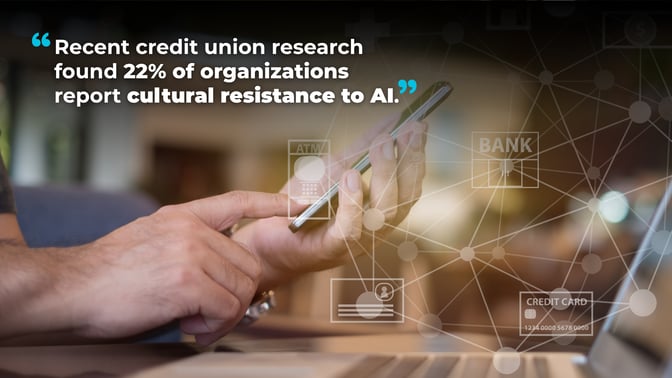
Inside your institution, the picture is likely similar. Recent credit union research found 22% of organizations report cultural resistance to AI.[3] When all those voices echo the same concerns, that’s a signal worth listening to.
The institutions that win the next three years won’t be the ones with the loudest AI announcements. They’ll be the ones whose members and staff never have to wonder whose side the institution is on.
The regulators are behind you, not ahead of you
The GAO flagged in May 2025 that NCUA’s oversight tools don’t fully cover the technology service providers credit unions increasingly depend on.[9] The NCUA’s own AI compliance plan emphasizes internal controls but acknowledges the agency hasn’t deployed public AI use cases of its own.[12] The OCC, Fed, and FDIC updated model-risk guidance in 2026 and signaled more AI-specific material is coming.[10]
“Coming” doesn’t help when an examiner walks in next month. You’re on the hook for AI risk management now, even where formal rules remain incomplete. This means writing your own acceptable-use policy, your own model inventory, your own human-review standard, your own vendor controls. If you wait for federal clarity, you’ll be writing those policies under examination pressure with no time to think.
The decision underneath the decision
The most important choice facing every community FI executive right now isn’t which AI vendor to pick. The actual decision is this. Can every vendor commitment you make or new AI project you launch be unwound next year without breaking the FI or losing trust with your members and customers?
Look at every AI contract sitting on your desk and run a stress test. If this vendor goes the way of Builder.ai, what does it cost me to walk away? If members tell my front-line staff they don’t want to talk to an AI bot, can my contract accommodate a pivot back to human service? If the regulators write a rule I haven’t read yet, will my deployment survive it? Do I have an alternative if these AI experiments fail?
Here’s a pragmatic approach to AI launches. Treat every AI initiative as an experiment, not a commitment. Define what success looks like before you start, and define what failure looks like with equal honesty. Then communicate the experiment internally and externally before it launches, not after it stumbles. Meanwhile, keep an alternative channel running alongside, so a vendor collapse or a product that underdelivers is a pivot, not a crisis. Hope for the best, but plan for the worst.
The institutions that come out of this period strongest will be the ones that build an AI strategy that is adaptable to rapid changes and is rewritten or updated constantly.
The beginning, not the end for AI
Gartner’s Hype Cycle has a name for the moment we’re in. After the peak of inflated expectations comes the trough of disillusionment. The slide down from the peak feels like failure. It usually isn’t. It’s where bad ideas get purged, overly rosy claims get traded for hard questions, and the technology that actually works separates itself from what was mostly narrative.
The good news is, the hype cycle doesn’t end at disillusionment. What follows is the slope of enlightenment, then the plateau of productivity. We’re not there yet. But the institutions that understand where we are will be the ones who used this moment to experiment, learn, and ask themselves the right questions. The FIs that are humble, teachable, and change their minds the fastest, without burning down the bank, will be the clear winners.
About the Author: Jed Taylor
FTSI invited Jed Taylor to guest write this blog. Jed has spent his career bringing innovative solutions to banks and credit unions. He is the former President of uGenius (creator of the ITM) and former CEO of POPio (mobile video lending), and served as NCR's Global Head of Branch Solutions. He has been a friend and collaborator with FTSI for many years. Jed has been a featured speaker at industry conferences and a regular voice on financial services podcasts.
References
[1] UCF students boo commencement speaker over AI praise — 404 Media
[2] Klarna changes its AI tune and again recruits humans for customer service — CX Dive
[3] The AI Adoption Journey: A Survey of Credit Union Leaders — Filene Research Institute
[4] Most Americans say AI development is moving too fast — Economist/YouGov Poll
[5] Gen Z’s AI Adoption Steady, but Skepticism Climbs — Gallup
[6] Pope Leo calls to ‘disarm’ AI in major document — National Catholic Reporter
[7] 5 fintech industry trends shaping modern procurement — Zip
[8] Microsoft-Backed Builder.ai to Enter Insolvency Proceedings — TechCrunch
[9] Artificial Intelligence: Use and Oversight in Financial Services — U.S. GAO